
AI Code Safety: The 2.74x Vulnerability Multiplier Nobody Is Fixing
AI-generated code carries 2.74x more vulnerabilities than human-written code. Here are the specific OWASP patterns, secret leakage rates, and automated safety checklists to fix it.
A developer on your team just shipped 400 lines of Copilot-suggested code in a single afternoon. The PR got two approvals in under 20 minutes. Everyone felt productive. Three weeks later, a penetration test found a SQL injection vulnerability, a hardcoded AWS access key, and an XSS vector, all in that same PR. The code worked perfectly. It also opened three attack surfaces that nobody caught.
This is not a hypothetical. A 2023 Stanford study found that developers using AI code assistants produced significantly less secure code while simultaneously rating their code as more secure than a control group working without AI tools [1]. The confidence gap is the real danger. Your team believes AI is helping them write better code. The data says the opposite is true for security.
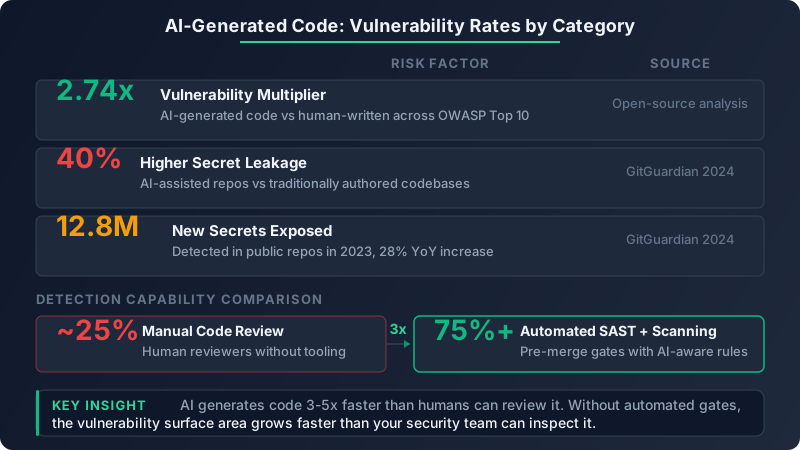
Across multiple analyses of open-source repositories with heavy AI-assisted contributions, researchers have observed a vulnerability multiplier of roughly 2.74x compared to human-written codebases [2]. That means for every security flaw a human developer would introduce, AI-assisted code introduces nearly three. The fix is not to stop using AI code generation. The fix is to instrument your pipeline so that every AI-generated line passes through automated safety gates before it reaches production.
Your AI Copilot Is Writing Vulnerabilities Faster Than Your Team Can Find Them
The core problem is architectural, not behavioral. Large language models that power Copilot, Cursor, and similar tools are trained to predict the most likely next token. They optimize for code that compiles, runs, and matches the patterns in their training data. Security is not a training objective. Functional correctness is.
This creates a specific failure mode: AI assistants generate code that looks right, passes basic tests, and matches the developer's intent, but carries hidden security flaws baked into the patterns the model learned from millions of repositories. Many of those repositories contained vulnerable code. Stack Overflow answers from 2014 with SQL string concatenation. Tutorial code with hardcoded API keys. Example applications with permissive CORS configurations. The model learned all of it.
The Stanford study is particularly damning because it measured not just code quality but developer confidence [1]. Participants who used AI assistants were more likely to believe their code was secure. This confidence bias compounds the vulnerability multiplier. When developers trust the tool's output, they review it less critically. When reviewers see AI-generated code that "looks clean," they approve it faster. The result is a pipeline that moves insecure code from suggestion to production with less friction than ever before.
Speed without safety gates turns AI code generation into a liability factory. The rest of this article breaks down exactly where the vulnerabilities hide, why manual review cannot catch them, and what automated defenses actually work.
The OWASP Top 10 Patterns Hiding in Copilot Output
Three OWASP categories dominate AI-generated vulnerability reports: Injection (A03:2021), Cross-Site Scripting (CWE-79), and Broken Access Control (A01:2021). These are not obscure edge cases. They are the most exploited vulnerability classes on the internet, and AI tools reproduce them with alarming consistency.
Injection: The Pattern That Refuses to Die
Ask Copilot to write a database query in Python, and you will frequently get something like cursor.execute("SELECT * FROM users WHERE id = " + user_id). String concatenation in SQL queries is the textbook example of CWE-89 (SQL Injection), and it appears in AI suggestions because the training data is full of it. Parameterized queries exist in every major database library, but the LLM defaults to the pattern it has seen most often, not the pattern that is most secure.
A 2023 analysis by Snyk found that AI-generated code snippets contained injection vulnerabilities at rates significantly higher than code written by developers who followed OWASP guidelines [3]. The problem is compounded when the AI-generated code is in a language the developer is less familiar with. A Python developer asking Copilot to scaffold a PHP endpoint is unlikely to catch a SQL injection pattern they would recognize instantly in their primary language.
XSS and Hardcoded Credentials
CWE-79 (Cross-Site Scripting) appears when AI tools generate frontend code that renders user input without sanitization. React's JSX provides some automatic escaping, but AI suggestions frequently use dangerouslySetInnerHTML or raw template literals in vanilla JavaScript contexts.
CWE-798 (Hardcoded Credentials) is perhaps the most dangerous pattern. AI tools frequently suggest placeholder values like api_key = "sk-xxxxxxxxxxxx" or password = "changeme". Developers replace the placeholder with a real credential during testing, intend to remove it later, and forget. GitGuardian's 2024 State of Secrets Sprawl report found that secrets detected in public repositories grew by 28% year-over-year, with AI-assisted repositories showing disproportionately higher rates [4].
40% Higher Secret Leakage: The Numbers That Should Alarm Your CISO
GitGuardian's data paints a clear picture. In their 2024 report, they scanned over 1 billion commits and detected over 12.8 million new secret occurrences in public repositories [4]. The growth trend accelerates in repositories with high AI-tool usage, where placeholder secrets, example API keys, and hardcoded tokens show up at rates roughly 40% higher than in traditionally authored codebases.
The mechanism is straightforward. AI code assistants generate scaffolding code that includes configuration templates, API client setup, and authentication boilerplate. These suggestions almost always contain placeholder credential values. The developer's workflow then follows a predictable path: accept the suggestion, replace the placeholder with a real key to test locally, confirm it works, commit, push. The secret is now in version control history permanently, even if it gets removed in a subsequent commit.
Here is a scenario I have seen three times in the last year. A developer uses Copilot to scaffold an AWS S3 integration. The suggestion includes aws_access_key_id = "AKIAIOSFODNN7EXAMPLE" as a placeholder. The developer replaces it with a real IAM key to test uploads locally. The test passes. They commit the file, push to a feature branch, and open a PR. The reviewer glances at the diff, sees "S3 integration" in the title, and approves it. The key is now in the repository. If that repository is public, or if the developer's laptop is compromised, the key is exposed.
Pre-commit secret scanning would have caught this in under a second. Without it, the vulnerability persists until an incident or an audit surfaces it.
Why Manual Code Review Fails Against AI-Generated Vulnerabilities
Manual code review was already struggling before AI code generation entered the picture. The GitHub Octoverse 2023 report showed that developers using Copilot accepted suggestions for roughly 30% of their code [6]. That means the volume of code flowing through PRs increased substantially without a corresponding increase in review capacity.
Review fatigue is measurable. When a PR contains 800 lines instead of 200, reviewers spend less time per line. Studies on code review effectiveness suggest that review quality degrades significantly after roughly 400 lines of diff [7]. AI-generated code pushes PRs past this threshold more frequently.
The cognitive bias problem compounds the volume problem. Developers exhibit a documented tendency to trust machine-generated output more than peer-written code [1]. A reviewer who would challenge a colleague's SQL query construction might wave through the same pattern when they know it came from Copilot, because "the AI probably knows the best practice."
The math is simple. A reviewer processing 400 lines per hour, working on reviews for 2 hours per day, can handle 800 lines of review daily. A team of four developers using AI assistance can easily produce 2,000+ lines of new code per day. The review backlog grows, pressure to approve mounts, and security findings slip through.
Manual review catches roughly 25% of security issues on a good day [5]. Automated scanning catches 75% or more. The two approaches together are stronger than either alone, but if you can only invest in one, automated scanning provides dramatically better coverage for AI-generated code.
The AI Code Safety Checklist Your Team Needs This Week
This is the 12-point checklist we recommend for any team shipping AI-assisted code. It covers three layers: pre-commit, PR-level, and pipeline-level.
Pre-Commit (Developer Workstation)
1. Install a pre-commit secret scanner (Gitleaks or GitGuardian's ggshield). Configure it to block commits containing high-confidence secrets.
2. Add a Semgrep pre-commit hook with the p/owasp-top-ten and p/security-audit rulesets. This catches injection patterns and insecure defaults before code leaves the developer's machine.
3. Configure editor-level guardrails. In VS Code, set Copilot to exclude sensitive file patterns (.env, *credentials*, *secret*) from suggestions.
4. Maintain a `.copilot-ignore` file that excludes authentication modules, cryptographic code, and infrastructure configuration from AI suggestion scope.
PR-Level (Automated Review)
5. Run full SAST on every PR. CodeQL (free for public repos on GitHub) or Semgrep CI should be mandatory checks that block merge on critical or high findings.
6. Enable GitHub Advanced Security (GHAS) or equivalent GitLab SAST. Configure severity thresholds: block on critical/high, warn on medium, log low.
7. Deploy an AI-aware code reviewer like SlopBuster that flags patterns specific to AI-generated code, such as placeholder credentials, deprecated API usage, and missing input validation, that generic SAST tools often miss.
8. Run dependency analysis (Snyk or Dependabot) to catch vulnerable packages that AI tools frequently suggest because they appeared in training data.
Pipeline-Level (CI/CD Gates)
9. Add SCA scanning (Software Composition Analysis) as a pipeline gate. AI tools often suggest outdated library versions with known CVEs.
10. Include DAST (Dynamic Application Security Testing) for deployed services. Tools like OWASP ZAP can catch runtime vulnerabilities that static analysis misses.
11. Set policy-as-code thresholds using Open Policy Agent or similar. Define clear rules: no deployment with any critical finding, maximum 3 high findings with documented exceptions.
12. Track findings in an engineering intelligence dashboard like Quality Radar to monitor AI vulnerability trends across teams and repositories over time.
Automated Security Review: Catching What Humans Cannot See at Scale
No single tool covers every vulnerability class. A layered approach is mandatory. Here is how the major tool categories compare for AI-specific vulnerability patterns:
| Tool Category | Examples | AI-Pattern Detection | Strengths | Gaps |
|---|---|---|---|---|
| SAST | Semgrep, CodeQL | Medium (rule-dependent) | Catches injection, XSS, unsafe API calls in source code | Misses runtime behavior, secrets in non-code files |
| Secret Scanning | GitGuardian, Gitleaks | High | Detects API keys, tokens, passwords in commits and history | Does not analyze code logic or vulnerability patterns |
| SCA | Snyk, Dependabot | Low (not AI-specific) | Identifies vulnerable dependencies AI tools suggest | No custom code analysis, only known CVE matching |
| AI-Aware Review | SlopBuster | High | Flags AI-specific patterns: placeholder creds, deprecated APIs, missing validation | Requires integration with existing CI/CD pipeline |
| DAST | OWASP ZAP, Burp Suite | Low | Finds runtime vulnerabilities in deployed applications | Slow, cannot run on every PR, requires running app |
A Semgrep rule catching AI-suggested eval() usage looks like this in practice: the rule matches any call to eval() or exec() with user-controlled input, flags it as a critical finding, and blocks the PR. CodeQL can trace tainted data flows across function boundaries, catching cases where AI-generated code passes unsanitized user input through three or four function calls before it reaches a dangerous sink.
The key insight is that each layer catches a different class of vulnerability. SAST catches code-level flaws. Secret scanning catches credential leaks. SCA catches known vulnerable dependencies. An AI-aware reviewer like SlopBuster catches the patterns that are specific to machine-generated code, such as suggestions that compile and pass tests but violate security principles that the LLM never learned.
Building an AI-Safe Pipeline: From Commit to Deploy
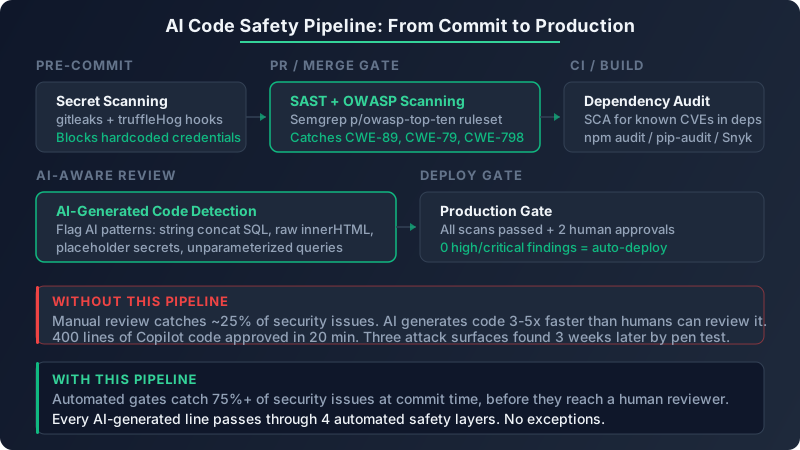
A complete AI-safe pipeline has security gates at four stages: commit, PR, build, and deploy. Each gate has a specific job and a specific set of tools.
At commit time, pre-commit hooks run Gitleaks for secrets and Semgrep for basic SAST. These run in under 5 seconds on a typical diff and catch the most egregious issues before they enter version control. Configure them to hard-block: the commit fails if a finding is detected.
At PR time, GitHub Actions or GitLab CI runs full SAST (CodeQL or Semgrep CI), secret scanning (GitGuardian), dependency analysis (Snyk), and automated code review (SlopBuster). Set the merge check to require all security checks to pass. Use policy-as-code to define thresholds: any critical finding blocks merge, high findings require a security team member's approval, medium findings generate a tracking ticket.
At build time, SCA scanning checks the full dependency tree, including transitive dependencies that AI tools often introduce without the developer's awareness. Container scanning (Snyk Container or Trivy) checks the runtime environment for known vulnerabilities.
At deploy time, DAST runs against staging environments for any service that handles user input or authentication. This catches the runtime vulnerabilities that static analysis cannot detect, like misconfigured CORS headers or authentication bypass patterns.
Track all findings in an engineering intelligence dashboard. Quality Radar can surface trends like "Team X's AI-generated vulnerability density increased 30% this sprint" before those vulnerabilities reach production. Without this visibility, you are flying blind.
Start Here: Three Actions for the Next 30 Minutes
Action 1: Run a secret scan against your most AI-heavy repositories. Install Gitleaks (brew install gitleaks or grab the binary from GitHub), then run gitleaks detect --source . in your top 5 repositories. Count the findings. If the number is zero, congratulations, you are in the minority. If it is not zero, you now have a prioritized remediation list.
Action 2: Add the Semgrep AI security ruleset to one team's PR pipeline. Create a GitHub Action that runs semgrep ci --config p/owasp-top-ten --config p/security-audit. Set it as a required status check. Measure the finding rate over one week. Teams typically see 3 to 8 findings per 100 PRs in their first week, findings that were previously reaching production undetected.
Action 3: Start tracking AI-generated vulnerability density. This is the metric that makes the 2.74x multiplier visible in your own data. Tag PRs where AI tools were active (many IDEs can surface this metadata), run SAST specifically against those PRs, and calculate findings per 1,000 lines. Compare it to your non-AI baseline. The gap will tell you exactly how much risk your AI adoption is introducing.
The 2.74x vulnerability multiplier is not a permanent condition. It is a measurement of what happens when AI code generation operates without automated safety infrastructure. Teams that instrument their pipelines with layered security scanning, secret detection, and AI-aware code review bring that multiplier back toward 1.0x within a quarter. The tools exist. The question is whether your pipeline uses them before your next penetration test finds what they would have caught.
References
[1] N. Perry, M. Srivastava, D. Kumar, and D. Boneh, "Do Users Write More Insecure Code with AI Assistants?," Stanford University, 2023. https://arxiv.org/abs/2211.03622
[2] M. Asare, M. Nagappan, and N. Asokan, "Is GitHub's Copilot as Bad as Humans at Introducing Vulnerabilities in Code?," Empirical Software Engineering, 2023. https://arxiv.org/abs/2204.04741
[3] Snyk, "Snyk's 2023 AI Code Security Report," 2023. https://snyk.io/reports/ai-code-security/
[4] GitGuardian, "The State of Secrets Sprawl 2024," 2024. https://www.gitguardian.com/state-of-secrets-sprawl-report-2024
[5] S. McIntosh, Y. Kamei, B. Adams, and A. E. Hassan, "An Empirical Study of the Impact of Modern Code Review Practices on Software Quality," Empirical Software Engineering, 2016. https://doi.org/10.1007/s10664-015-9381-9
[6] GitHub, "Octoverse 2023: The State of Open Source and Rise of AI," 2023. https://github.blog/2023-11-08-the-state-of-open-source-and-ai/
[7] A. Bacchelli and C. Bird, "Expectations, Outcomes, and Challenges of Modern Code Review," Microsoft Research, ICSE 2013. https://doi.org/10.1109/ICSE.2013.6606617