
The Hidden Cost of AI-Generated Technical Debt: A 90-Day Spike Pattern
AI-generated code ships fast but compounds technical debt silently. Data from GitClear and real incident postmortems reveals the 90-day spike pattern and how to stop it.
Your team just closed its fastest quarter ever. Forty percent more PRs merged. Sprint velocity charts pointing up and to the right. The engineering all-hands has a celebratory tone because Copilot and Cursor adoption finally hit critical mass across the org. Then Q2 arrives. Incident tickets start climbing. On-call rotations get heavier. A P1 outage traces back to error handling code that nobody on the team remembers writing, because nobody did. An AI assistant generated it, a reviewer approved it, and production exposed what staging never could.
This pattern is not hypothetical. GitClear's 2024 analysis of 211 million lines of code found that code churn (lines reverted or updated shortly after being written) increased significantly in repositories with heavy AI assistant usage, with moved and copied code rising as a share of total changes [1]. The data tells a clear story: AI-generated code enters codebases faster than teams can build understanding of it. And that gap between shipping speed and comprehension has a price tag that shows up roughly 90 days later.
Here is the core thesis, and it is not subtle: AI-generated technical debt behaves nothing like human technical debt. It accumulates silently, at higher volume, with less institutional knowledge attached to it. If your engineering leadership is tracking velocity without tracking debt composition, you are building a dashboard that lies to you.
Your Fastest Quarter Is Hiding Your Most Expensive Year
The velocity illusion starts at the PR level. When engineers adopt AI coding assistants, the immediate effect is predictable: more code, faster. GitHub's own research showed that developers using Copilot completed tasks 55% faster than those without it [2]. That number gets cited in every adoption pitch. What does not get cited is what happens to that code 60, 90, 120 days later.
GitClear's data revealed that AI-assisted repositories saw higher rates of "churn code," defined as lines that are reverted or substantially changed within two weeks of being written [1]. This metric matters because churn is a reliable leading indicator of code that was not well understood at commit time. When a human writes code they do not fully understand, they usually know they do not understand it. When an AI generates code that a human approves without fully understanding it, neither party flags the risk.
The compounding effect is what makes this dangerous. A team that ships 40% more code per quarter with AI assistance is also shipping 40% more surface area for future incidents, with less per-line comprehension than their pre-AI baseline. The fast quarter does not pay for itself if it generates enough incidents and rework to consume the next two quarters of engineering capacity.
The 90-Day Incident Spike Nobody Budgeted For
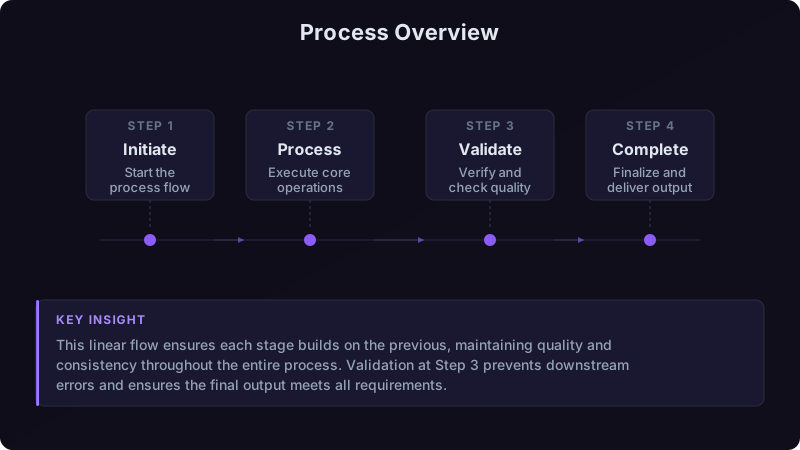
Here is the pattern I have seen repeat across multiple organizations. In month one, AI-generated code passes code review (because it looks correct and often is syntactically clean). In month two, it passes integration testing (because test environments do not expose the edge cases that production traffic creates). In month three, production load, real user behavior, and system interactions start surfacing the failure modes that were baked in from day one.
The most common failure pattern is silent exception swallowing. AI assistants are trained on massive codebases where try-catch blocks with generic exception handlers are common. The generated code often catches broad exception types, logs nothing meaningful (or logs at DEBUG level), and returns default values. In staging, this looks like working software. In production, it creates silent data corruption, dropped transactions, and cascading failures that surface as symptoms far removed from the root cause.
The shadow AI tool proliferation problem makes this worse. When CIOs estimate AI tool usage, they typically report 60 to 70 tools across the organization, but monitoring reveals 200 to 300 in actual use [3]. That 3 to 4x gap means engineering leaders do not even have accurate estimates of how much AI-generated code exists in their codebase. You cannot govern what you cannot see, and you cannot see what you are not measuring.
Teams without AI code governance structures frequently report that incident rates compound after the 90-day mark. The correlation makes sense: that is the window where edge cases, scale effects, and integration complexity start exercising the code paths that never ran during initial validation.
Why AI Debt Compounds Differently Than Human Debt
When a human engineer writes a quick hack and ships it, they carry a mental model of what they cut corners on. They know where the bodies are buried. That institutional knowledge means the original author can often fix the debt efficiently, or at minimum explain it during a postmortem. AI-generated code has no author with a mental model. The person who prompted the generation may not have read every line. The reviewer who approved it definitely did not internalize every implementation decision.
This is the copy-paste amplification problem at scale. Copilot and Cursor generate similar but subtly different implementations across files. You end up with six slightly different retry mechanisms, four variations of the same database connection pooling pattern, and three incompatible approaches to input validation, all in the same service. Each one works individually. Together, they create a maintenance surface that no single engineer can reason about efficiently.
Traditional SAST tools miss AI-specific vulnerability patterns. PCI DSS 4.0 Requirement 6.2.4 now mandates automated code review tools, acknowledging that manual review alone cannot catch the volume of issues modern development produces [5]. But most SAST tools are pattern matchers. They catch known vulnerability signatures. AI-generated code introduces novel combinations of technically-valid-but-practically-dangerous patterns that do not match existing rules.
The reliability compounding math applies here too. In multi-agent AI systems, five components at 95% reliability each yield only 77% system reliability (.95^5 = .77). The same principle applies to AI-generated code components. Each individual function might be 95% correct across all inputs. But a service composed of dozens of AI-generated functions accumulates failure probability in ways that are not visible at the individual component level [6].
Measuring AI Technical Debt Before It Measures You
You cannot manage AI-generated debt with the same metrics you use for human-generated debt. I recommend three specific measurements.
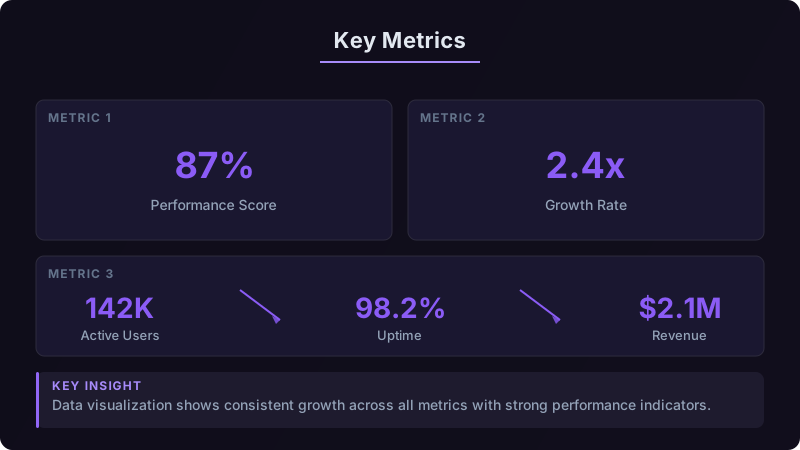
AI Code Churn Rate tracks the percentage of AI-generated lines that are modified or deleted within 90 days of being committed. This is your primary leading indicator. A healthy codebase sees churn rates under 15%. AI-heavy codebases without governance frequently see 25% or higher, which means a quarter of the AI-generated code is being rewritten within three months of shipping.
Technical Debt Ratio per AI-assisted file measures the ratio of remediation cost to development cost, segmented by whether the file was generated with AI assistance. This requires tagging AI-assisted commits at the metadata level, something most teams are not doing yet. Engineering intelligence dashboards can automate this segmentation when commit metadata includes AI assistant signals. This is exactly the kind of tracking that Connectory's Engineering Intelligence Dashboard is designed to surface, giving engineering leaders visibility into debt composition by code origin.
Time-to-Understand measures how long it takes a different engineer (not the original prompter) to make a meaningful modification to AI-generated code. If a function took 30 seconds to generate but takes 45 minutes for another engineer to understand well enough to modify safely, your effective productivity gain evaporates. Service health scores (similar to what platforms like Cortex track) degrade visibly when AI-generated components are not flagged and monitored separately.
The Governance Gap Between Velocity and Viability
Data from financial services, one of the most aggressive AI-adopting sectors, reveals the governance contradiction clearly. The sector reports 81% AI adoption with 40% at advanced stages [7]. Yet 78% of regulators rate explainability as critical, while only 50% of firms actually implement explainability measures [7]. The gap between adoption and governance is not closing. It is widening.
Map this pattern to engineering organizations. Most teams that have adopted Copilot or Cursor have some form of adoption policy: who gets licenses, what repos are enabled, maybe some guidelines on sensitive code. Almost none have AI code quality governance: structured rules about how AI-generated code is tagged, reviewed differently, monitored for debt accumulation, and retired when it exceeds quality thresholds.
Here is what the data suggests: governed environments show higher AI initiative success rates than ungoverned ones [3]. Governance does not slow down AI adoption. It prevents the blowback that slows down everything three months later.
A three-tier governance framework works well in practice. First, commit-level tagging to identify which code was AI-assisted. Second, review-level quality gates where tools like SlopBuster flag AI-generated code for additional scrutiny, particularly around error handling, boundary conditions, and performance characteristics. Third, portfolio-level debt tracking where engineering leadership sees aggregate Technical Debt Ratio trends segmented by AI vs. human origin.
A Practical Framework: The AI Debt Circuit Breaker
Here is a concrete, four-step framework that engineering teams can implement incrementally.
Step 1: Instrument your repos. Detect and tag AI-generated code using tool-level signals (Copilot telemetry, Cursor usage data), commit message conventions (enforce a tag like [ai-assisted]), and statistical detection for teams that did not start tagging early. IDE plugins can automate much of this.
Step 2: Set quality thresholds. When AI-generated files exceed churn benchmarks (our recommendation: flag at 20% churn within 90 days), trigger automatic escalation to senior engineer review. This is not about blocking AI usage. It is about creating feedback loops before incidents create them for you.
Step 3: Run 90-day AI code retrospectives. At the end of each quarter, pull all AI-assisted files committed 90 days prior. Check incident correlation, churn rate, and Time-to-Understand metrics. This retrospective catches the spike pattern while there is still time to address it.
Step 4: Establish AI code quality SLAs. Tie quality expectations to incident budgets, not just velocity metrics. If a team's AI-assisted code generates more than X% of total incidents relative to its codebase share, that triggers a governance review.
| Approach | Visibility | Incident Prevention | Team Overhead | Best For |
|---|---|---|---|---|
| No governance | None; AI code mixed with human code | Reactive only; incidents drive discovery | Zero initially, high later | Nobody (this is the default, not a choice) |
| Light tagging | Commit-level AI flags; basic reporting | Limited; no automated quality gates | Low; 2-3 min per PR for tagging | Teams just starting AI adoption |
| Quality gates | Tagged commits plus automated review escalation | Moderate; catches high-churn files early | Medium; adds ~10 min per flagged PR | Teams with 6+ months of AI tool usage |
| Full circuit breaker | End-to-end tracking, SLAs, 90-day retros | High; prevents the spike pattern | Medium-high; quarterly retro overhead | Teams where AI-assisted code exceeds 30% of commits |
What Two Incident Postmortems Taught Us About AI Code Failure Modes
Case 1: The Black Friday Cascade. An e-commerce platform had adopted Copilot across their backend team six months before their peak shopping event. AI-generated retry logic in their order processing service included a catch block that swallowed TimeoutException, logged a generic "request failed" message at INFO level, and returned an empty response. During normal traffic, timeouts were rare and the empty response triggered a client-side retry that succeeded. During Black Friday load, timeouts became frequent. The empty responses triggered millions of client retries. The retries amplified the timeout problem. The cascade took down order processing for 47 minutes during peak hours. The root cause was a seven-line AI-generated function that had been in production for four months without incident.
Case 2: The Demo-to-Production Gap. A SaaS company used Copilot to generate database query logic for a new analytics feature. The queries worked perfectly during demos and staging tests with 10,000 rows. In production with 8 million rows, the generated queries used correlated subqueries instead of joins, creating lock contention that degraded the entire database for all tenants. The fix required rewriting 23 AI-generated query functions. The engineer who did the rewrite estimated it took 3x longer to understand and fix the AI-generated code than it would have taken to write it correctly from scratch.
The common pattern in both cases: AI-generated code fails at boundaries (load boundaries, data scale boundaries, error boundaries) because training data biases toward happy-path implementations. The code works, until conditions diverge from the implicit assumptions baked into the training distribution.
Connect this to Veracode's finding that it takes an average of 252 days to fix half of outstanding vulnerabilities [4]. AI-generated vulnerabilities take even longer because there is no author context to accelerate the fix. Nobody knows why the code was written the way it was, because the answer is "an AI model predicted the next likely token."
Stop Counting PRs, Start Counting Debt Calories
Velocity metrics without debt metrics are a lie told with charts. A team shipping 100 PRs per month with a 30% AI churn rate is not faster than a team shipping 70 PRs per month with a 10% churn rate. The first team is generating 30 units of rework for every 100 units of output. The second team is generating 7. Run that math over four quarters and the "slower" team is dramatically more productive in terms of stable, production-ready code.
Your 30-minute action, starting today: pull your last 50 merged PRs. Flag which ones used AI assistance (ask the authors if you do not have tagging in place). Then cross-reference those PRs against your incident log for the subsequent 90 days. The correlation will either reassure you or alarm you, and either outcome is valuable.
The one metric to start tracking this week is AI Code Churn Rate: the percentage of AI-generated lines modified or deleted within 90 days of being committed. Set up a simple query against your git history. If you are using Connectory's Engineering Intelligence Dashboard or a similar platform, the segmentation can be automated.
Remember the team from the opening? The one celebrating their fastest quarter? That quarter only stays fast if the code survives contact with production. Shipping speed is a leading indicator. Incident rate is the trailing truth. The 90 days between those two measurements is where AI-generated technical debt either gets caught or gets expensive.
Stop celebrating PR counts. Start measuring what those PRs cost you three months later.
References
[1] GitClear, "Coding on Copilot: 2024 Data Suggests Downward Pressure on Code Quality," 2024. https://www.gitclear.com/coding_on_copilot_data_shows_ais_downward_pressure_on_code_quality
[2] M. Kalliamvakou, "Research: Quantifying GitHub Copilot's Impact on Developer Productivity and Happiness," GitHub Blog, 2022. https://github.blog/2022-09-07-research-quantifying-github-copilots-impact-on-developer-productivity-and-happiness/
[3] Zylo, "2024 SaaS Management Index Report," 2024. https://zylo.com/report/saas-management-index/
[4] Veracode, "State of Software Security 2025," 2025. https://www.veracode.com/state-of-software-security-report
[5] PCI Security Standards Council, "PCI DSS v4.0: Requirement 6.2.4," 2022. https://www.pcisecuritystandards.org/document_library/
[6] Anthropic, "Building Effective Agents," 2024. https://www.anthropic.com/research/building-effective-agents
[7] NVIDIA and Evident AI, "The State of AI in Financial Services: 2024 Trends Report," 2024. https://www.nvidia.com/en-us/industries/finance/