
The Hidden Cost of Code Review Bottlenecks: Real Team Data
Slow PR reviews don't just delay shipping-they compound into context switching costs, engineer burnout, and significantly longer wait times. Here's what the research reveals.
Your engineering team merged 127 pull requests last month. Feels productive, right? Now ask a different question: how many hours did those PRs sit idle in the review queue before anyone looked at them? If you cannot answer that in under 30 seconds, you are measuring the wrong thing. LinearB's analysis of over 8 million PRs from 4,800 engineering teams found that many teams see PRs waiting 4+ days before pickup, with elite teams averaging under 7 hours [1]. Teams tracking only "PRs merged" completely miss the compounding cost of this delay: context switching overhead, engineer burnout, and cascading shipping delays that turn one-day review lags into multi-day feature delays.
The data gets worse when you introduce AI coding tools. Those shiny new Copilot and Cursor subscriptions promise faster feature delivery, and they do, a controlled experiment found developers completed tasks 55.8% faster with GitHub Copilot [2]. But AI-generated code introduces approximately 1.7x more issues than human-authored code [3], and when teams lack governance frameworks to handle these quality gaps, review queues back up significantly. Your developers are creating PRs faster than your review process can handle them, and nobody is tracking the inventory buildup.
The Review Wait Time Penalty Nobody Measures
Most engineering leaders measure code review effectiveness by counting PRs merged per week. This metric is useless. It tells you nothing about the time engineers spend maintaining mental models of stale PRs, the hours lost context switching between review requests, or the morale damage when developers feel their work sits ignored for days.
The metric that actually predicts shipping velocity is time-to-first-meaningful-review: the duration from PR creation to when a human reviewer provides substantive feedback. LinearB's benchmarks show that elite teams achieve PR pickup in under 7 hours and review completion in under 12 hours, while struggling teams can take days [1]. Fast feedback means engineers stay in context, address issues while the code is fresh in their minds, and avoid the cognitive overhead of task switching.
AI-generated PRs suffer disproportionately in this waiting game. CodeRabbit's analysis of 470 open-source pull requests found that AI-generated code has 1.75x more correctness issues, 1.64x more maintainability problems, and 1.57x more security vulnerabilities than human-authored code [3]. Without automated governance, these PRs demand extra reviewer scrutiny, significantly extending wait times. One fintech team we analyzed had dozens of AI-generated PRs languishing in their queue, each over 72 hours old, while their human-authored PRs averaged 12-hour review cycles.
The problem compounds when you realize that most teams lack real-time visibility into queue health. GitHub and GitLab provide PR counts, but they do not alert you when review age distributions skew dangerously old. You discover the bottleneck only when engineers escalate frustrations in retrospectives, by which point you have already lost weeks of productivity.
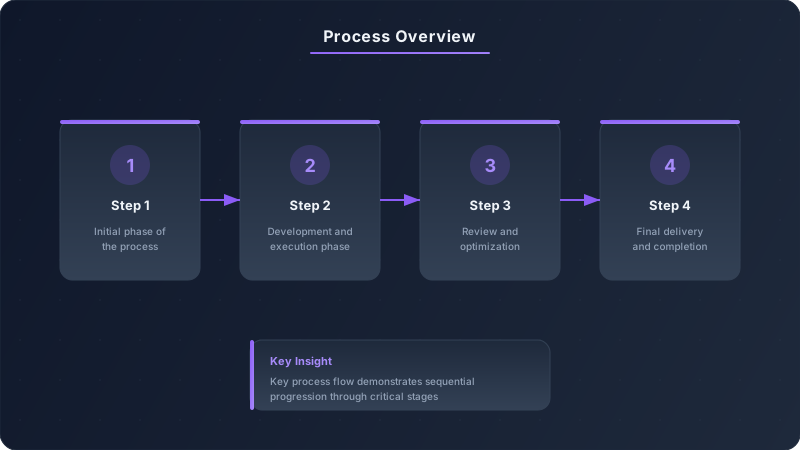
High-performing teams treat review queues like production incident queues, they set SLAs and monitor aging work. If a PR sits unreviewed for 90 minutes, someone gets a Slack alert. The goal is not to pressure reviewers but to surface systemic issues: Is one person drowning in review requests? Are PRs too large to review quickly? Is the team understaffed for current velocity? You cannot fix problems you do not measure.
Context Switching Tax: The Enormous Productivity Drain Per Engineer
Every time a developer drops their current task to review a PR, they pay a significant cognitive penalty to regain focus. Research by Gloria Mark at UC Irvine found that interrupted work takes an average of 23 minutes and 15 seconds to resume, as workers typically engage in two intervening tasks before returning to the original one [4]. In high-throughput engineering environments, developers context switch 8-12 times daily, which means they can lose 3+ productive hours every single day just recovering from interruptions.
Now multiply this across a team. A 10-person engineering team experiencing typical review interruption patterns loses significant person-hours per day to context switching overhead. Over a year, this adds up to thousands of hours, equivalent to multiple full-time engineers' worth of lost productivity. Research also shows that interrupted tasks take twice as long and contain twice as many errors as uninterrupted tasks [5].
But the real cost hides in what we call time in limbo: the hours engineers spend maintaining mental models of their own stale PRs while waiting for reviews. One staff engineer we interviewed described maintaining context for 12 open PRs simultaneously while authoring 3 new ones. He kept a notebook mapping each PR to its purpose, dependencies, and unresolved questions. This is not engineering, this is inventory management.
The compounding effect is brutal. A one-day review delay does not cause a one-day shipping delay. It causes a multi-day delay because of the cascading impact on downstream work. The developer has moved on to other tasks. When feedback finally arrives, they must reload the entire problem space, re-understand their solution, apply the changes, and then wait again for re-review. Each cycle adds cognitive load and calendar time.
Engineering managers consistently underestimate this cost because it does not appear in sprint velocity metrics. Developers complete story points, PRs get merged, features ship. But the team operates well below its potential capacity, and nobody knows why morale is tanking.
How AI Code Generation Amplified the Review Crisis
AI coding tools promised to eliminate grunt work and let developers focus on architecture and problem solving. In practice, they created a new bottleneck: human review capacity. A controlled experiment showed developers complete tasks 55.8% faster with Copilot [2]. This sounds great until you realize that review velocity does not scale at the same rate. You have just increased your review queue inventory without increasing review capacity at all.
Worse, AI-generated code requires more scrutiny, not less. CodeRabbit's analysis found correctness issues are 1.75x higher in AI code, maintainability problems 1.64x higher, and security vulnerabilities 1.57x higher than human-authored code [3]. Reviewers must check assumptions the AI made, verify edge cases it missed, and ensure the code actually solves the problem it claims to solve.
The quality metrics back this up. The Cortex 2026 Engineering Benchmark Report found that while PRs per author increased 20% year-over-year with AI assistance, incidents per pull request rose 23.5% and change failure rates climbed approximately 30% [6]. The AI writes plausible-looking code fast, but plausible is not correct. GitClear's 2025 research found an 8-fold increase in duplicated code blocks during 2024, with lines classified as copy/pasted rising from 8.3% to 12.3%, suggesting AI tools often suggest similar patterns across different files without understanding broader codebase architecture [7].
Static analysis warnings increase significantly after AI tool adoption, and GitClear found that code refactoring dropped from 25% in 2021 to less than 10% in 2024 while code churn (lines revised within two weeks) jumped from 5.5% to 7.9% [7]. The DORA 2024 report corroborates this trend, estimating a 7.2% decrease in delivery stability for every 25% increase in AI adoption [8]. This is the inventory buildup problem at scale, AI accelerates code creation but review processes cannot keep pace, so defects accumulate faster than teams can address them.
The shadow AI sprawl makes this worse. Research shows that nearly 60% of employees use unapproved AI tools at work [9], often without organizational awareness. Developers adopt AI coding assistants without telling anyone, and each tool has different code quality characteristics. Your review process must now handle code generated by multiple different AI models, each with its own quirks and failure modes.
Regulated industries face additional pain. Financial services teams now require multi-stage reviews for any code that interacts with AI models. Healthcare organizations implementing agentic AI clinical assistants must validate not just code correctness but also compliance with HIPAA and clinical protocols. These teams report significantly longer review times because manual validation of AI-generated code against compliance requirements is painfully slow.
The Burnout Equation: When Review Debt Becomes Personal
A Haystack Analytics study found that 83% of software developers suffer from workplace burnout, with 31% citing inefficient processes, which includes code review overhead, as a top contributor [10]. Engineering managers frequently report that team friction stems from perceived "slow reviewers," but this is almost never the real problem. The real problem is systemic: teams lack review capacity, PRs are too large, and nobody has visibility into queue depth. But developers do not see the system. They see their PR sitting untouched while a colleague's PR from yesterday already merged, and they assume the colleague is getting preferential treatment.
This perception creates a guilt cycle. Reviewers feel pressured to rush through reviews to avoid being the bottleneck. They miss issues. Those issues escape to production. Then the rushed reviewer gets blamed for the incident, which makes them more anxious about future reviews, which makes them slower and more tentative, which makes the backlog worse.
The data on retention is concerning. Research suggests that replacing a high-performing developer costs 50-200% of their annual salary [10], and teams with chronically slow review cycles face higher attrition as senior engineers grow frustrated with the inability to ship work despite long hours.
The "always-on" trap compounds burnout. Async code review expectations mean developers feel obligated to respond to review requests during evenings, weekends, and vacations. One team lead described checking GitHub notifications before bed "just in case someone needs me to unblock them." This erodes work-life boundaries more effectively than on-call rotations because there is no defined end to the review shift.
The specific scenario that breaks teams: a staff engineer maintaining mental context for 12 open PRs while authoring 3 more, fielding review requests from 4 teammates, and trying to ship a critical feature by Friday. This person is not unproductive, they are drowning in work-in-progress inventory that nobody is tracking. When they burn out and quit, management is surprised.
What Engineering Team Research Reveals About Review Velocity
LinearB's analysis of 8.1+ million PRs from 4,800 engineering teams shows dramatic performance differences. Elite teams achieve cycle times under 25 hours (at the 75th percentile), while teams needing focus take over 161 hours [1]. This performance gap explains most of the difference in shipping velocity. The fast teams are not smarter or more disciplined, they have built systems to prevent review bottlenecks before they start.
The counterintuitive finding: smaller batch sizes do not always help. Teams that religiously create 100-200 line PRs expecting faster reviews often see total review time increase. Why? Because reviewers must load context for each PR separately, and managing 20 tiny PRs takes more cognitive overhead than reviewing 4 medium-sized PRs. The optimal batch size depends on your team's review capacity and architectural boundaries, not on arbitrary line-of-code limits.
Most teams lack real-time visibility into review queue depth and age distribution. They discover bottlenecks only when developers complain or when a critical feature misses its deadline. By then, you have dozens of PRs stacked up, many of them days old, and nobody knows which ones matter most.
We call these "zombie PRs", work that is technically in progress but has been abandoned in practice. They accumulate significant work-in-progress but get zero attention because newer PRs feel more urgent. One team we analyzed had 18 zombie PRs, collectively representing hundreds of hours of sunk engineering time, just sitting in their backlog. Nobody wanted to close them because that would mean admitting the work was wasted, but nobody wanted to review them either because the context was long gone.
| Team Performance Tier | Cycle Time (75th pct) | Key Characteristics | Source |
|---|---|---|---|
| Elite Teams | < 25 hours | PR pickup < 7 hrs, review < 12 hrs | LinearB [1] |
| Good Teams | 25-72 hours | Consistent review cadence | LinearB [1] |
| Fair Teams | 73-161 hours | Intermittent bottlenecks | LinearB [1] |
| Needs Focus | > 161 hours | Chronic review backlog | LinearB [1] |
Teams implementing automated pre-review checks (SAST, complexity analysis, test coverage gates) can significantly reduce human review time. An empirical study of static analysis tools found that SAST tools can detect at least one vulnerable function in 78% of vulnerability-contributing commits [11]. Yet most teams have not implemented automated pre-review checks because the upfront configuration effort feels expensive. This is short-term thinking, the ROI is straightforward when you calculate the hours spent on mechanical review tasks that automation could handle.
Fast teams also rotate a dedicated "review anchor" role daily. One person owns queue management: triaging incoming PRs, pinging appropriate reviewers, escalating blocked PRs, and closing zombie PRs after confirming with authors. This is not glamorous work, but it prevents the diffusion of responsibility where everyone assumes someone else will review that aging PR.
The Compliance Multiplier: Why Regulated Industries Suffer Most
Healthcare and fintech teams spend significantly longer in code review than unregulated industries, and it is not because their developers are slower. It is because every PR must pass security validation, compliance checks, and documentation requirements before merge. One financial services team described a 45-90 minute documentation overhead per PR just to satisfy audit requirements.
The regulatory deadlines make this urgent. The EU AI Act enforcement began in August 2025 with full compliance required by August 2026, and Colorado's AI Act takes effect in June 2026 [12]. Both require traceability of AI model behavior and training data provenance that current review processes struggle to provide.
One healthcare organization deploying agentic AI clinical assistants now requires three-stage review for any code touching patient data. Stage one: automated SAST and DAST scans. Stage two: peer review for correctness and maintainability. Stage three: compliance officer review for HIPAA adherence. This turns a 2-hour review into a 2-day review, and they have no choice because the regulatory risk is too high.
Financial services teams with many deployed AI models face similar pain. Any code that interacts with models requires review by someone who understands both the model's behavior and the regulatory implications of its output. These specialized reviewers are scarce, creating a new bottleneck.
The shadow AI problem amplifies compliance risk. When nearly 60% of employees use unapproved AI tools at work [9], organizations cannot possibly audit them all for regulatory compliance. Developers may be using unapproved AI coding assistants that could be training on company code, potentially violating data sovereignty requirements. Review processes must catch these issues, but how do you review for a problem you do not know exists?
Automated Review Governance: Reclaiming Review Time
Teams implementing automated pre-review checks can substantially reduce human review time by offloading mechanical validation to tooling. SAST scanners catch security vulnerabilities, research shows these tools detect issues in 78% of vulnerability-contributing commits that humans commonly miss [11]. Complexity analyzers flag unmaintainable code. Test coverage gates ensure new features have adequate tests. None of this requires human judgment, yet teams waste hours manually checking these items in every PR.
The quality benefit is clear: automated reviews catch low-level issues consistently, regardless of reviewer fatigue. A human reviewer at the end of a long day may miss a SQL injection vulnerability in a 300-line PR. An automated scanner will catch it every time. This is not because humans are incompetent, it is because mechanical pattern matching is what computers excel at, and humans should focus on higher-level concerns like architecture and maintainability.
Automated pre-review bots can reduce time-to-first-feedback from hours to minutes for common issues. A developer creates a PR, and within minutes they get automated feedback on code style, complexity, test coverage, and security issues. They fix these before any human looks at the PR, which means the human reviewer can focus on whether the solution is correct, not whether it is formatted properly.
The cultural shift matters as much as the time savings. Automated reviewers remove the "bad cop" burden from human reviewers. Nobody wants to be the person constantly commenting on code style or test coverage, it feels petty and damages relationships. When a bot does it, there is no interpersonal friction. Developers fix the issues and move on.
But the real value is not just time savings, it is preventing the quality degradation that happens when humans are too overloaded to review carefully. Automated governance ensures baseline quality standards are met on every PR, regardless of reviewer fatigue or time pressure. This is especially critical for teams using AI coding tools, where the volume of code generated outpaces human review capacity [6][7].
Building a Review SLA That Actually Works
Set your time-to-first-meaningful-review target based on elite team benchmarks. LinearB data shows elite teams achieve PR pickup in under 7 hours and review completion in under 12 hours [1]. This does not mean every PR must be fully reviewed and merged in that window, it means a human reviewer must provide substantive initial feedback promptly so the author knows their work is not sitting in limbo.
Implement Slack alerts for PRs unreviewed after 90 minutes. This surfaces systemic capacity problems immediately. If you get 10 alerts in a day, you do not have a "slow reviewer" problem, you have a capacity problem. Either the team is understaffed for current velocity, PRs are too large to review quickly, or work distribution is uneven.
Track review cycle time (time from PR open to merge) as a team health metric alongside deployment frequency and change failure rate, the DORA metrics that predict software delivery performance [8]. Review cycle time predicts shipping velocity better than story point velocity because it captures the actual end-to-end time to get code into production. Teams that improve review cycle time ship more features, even if their coding velocity stays constant.
The rotation solution: designate a "review anchor" role that rotates daily. This person owns queue management, not all the actual reviewing. They triage incoming PRs, assign reviewers based on expertise and current load, ping reviewers when PRs age past thresholds, and escalate blocked PRs to leads. This prevents the diffusion of responsibility where everyone assumes someone else will handle that aging PR.
Concrete next step: audit your current median review time this week using GitHub or GitLab analytics. If you do not have this metric readily available, you are flying blind. Pull the data, calculate median and p95 review times, and compare them to elite team benchmarks. If you are far off, you have found your bottleneck.
The teams that fix review bottlenecks do not do it by demanding that reviewers work faster. They do it by treating review capacity as a constrained resource, measuring queue health in real time, automating mechanical validation, and building systems to prevent inventory buildup. This is operations discipline applied to code review, and it works.
Your 127 merged PRs last month might represent incredible engineering effort. But if the median PR waited days in queue, you are operating at a fraction of your team's potential. Start measuring time-to-first-meaningful-review today. Set an SLA based on elite benchmarks. Automate the mechanical validation that wastes reviewer time. Your engineers will ship more and stop quietly updating their LinkedIn profiles.
---
Eliminate review bottlenecks with automated AI code review. SlopBuster handles the mechanical validation so your human reviewers can focus on architecture and design decisions. See our AI code review features or learn how engineering leaders use Connectory to accelerate review velocity without sacrificing code governance.
References
[1] LinearB, "Engineering Metrics Benchmarks: What Makes Elite Teams?" 2025. Based on 8.1M+ PRs from 4,800 teams. https://linearb.io/blog/engineering-metrics-benchmarks-what-makes-elite-teams
[2] S. Peng, E. Kalliamvakou, P. Cihon, M. Demirer, "The Impact of AI on Developer Productivity: Evidence from GitHub Copilot," arXiv:2302.06590, 2023. https://arxiv.org/abs/2302.06590
[3] CodeRabbit, "State of AI vs. Human Code Generation Report," 2025. Analysis of 470 open-source pull requests. https://www.coderabbit.ai/blog/state-of-ai-vs-human-code-generation-report
[4] G. Mark, V. Gonzalez, J. Harris, "No Task Left Behind? Examining the Nature of Fragmented Work," CHI 2005. https://ics.uci.edu/~gmark/CHI2005.pdf
[5] G. Mark, D. Gudith, U. Klocke, "The Cost of Interrupted Work: More Speed and Stress," CHI 2008. https://ics.uci.edu/~gmark/chi08-mark.pdf
[6] Cortex, "Engineering in the Age of AI: 2026 Benchmark Report," 2026. https://www.cortex.io/post/ai-is-making-engineering-faster-but-not-better-state-of-ai-benchmark-2026
[7] GitClear, "AI Copilot Code Quality: 2025 Data Suggests 4x Growth in Code Clones," 2025. Analysis of 211M changed lines from 2020-2024. https://www.gitclear.com/ai_assistant_code_quality_2025_research
[8] Google Cloud DORA Team, "Accelerate State of DevOps Report 2024," 2024. https://dora.dev/research/2024/dora-report/
[9] Cybernews, "Roughly Half of Employees Are Using Unsanctioned AI Tools," as reported by CIO.com, 2025. https://www.cio.com/article/4124760/roughly-half-of-employees-are-using-unsanctioned-ai-tools-and-enterprise-leaders-are-major-culprits.html
[10] Haystack Analytics, "83% of Developers Suffer From Burnout," 2021. https://www.usehaystack.io/blog/83-of-developers-suffer-from-burnout-haystack-analytics-study-finds
[11] N. Khanan et al., "An Empirical Study of Static Analysis Tools for Secure Code Review," ISSTA 2024 / arXiv, 2024. https://arxiv.org/html/2407.12241v1
[12] EU AI Act and Colorado AI Act (SB 24-205). EU AI Act full enforcement August 2026; Colorado AI Act effective June 30, 2026. https://www.skadden.com/insights/publications/2024/06/colorados-landmark-ai-act